ACOS: An Information-Theoretic Framework of Adjacency Compression and Observable Shells for UAP Detection

To the point

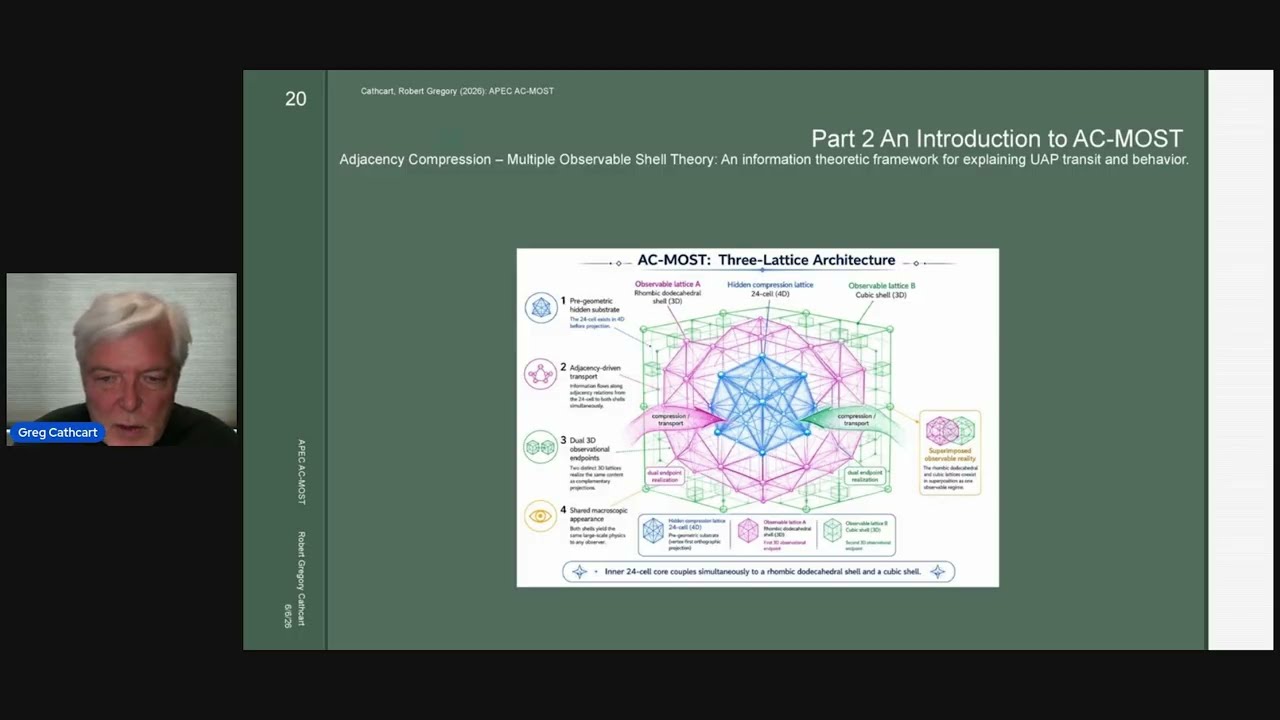
Robert Gregory Cathkaro presents ACOS, a new information-theoretic framework claiming that reality and UAP behavior arise from compressed core information registered across a hidden 24-cell core and two observable shells—a rhombic dodecahedral shell A and a cubic shell B—and that shaping these shells with electromagnetic fields, metamaterials, and feedback could enable detection, classification, and prediction of anomalies, with the theory being falsifiable and potentially transformative.
IR in Anomalous Transit and Adjacency Compression Theory (ACT) |  Greg Cathcart
youtu.be

IR in Anomalous Transit and Adjacency Compression Theory (ACT) | Greg Cathcart

Greg Cathcart introduces AC-MOST, a bold information-theoretic framework that asks whether UAP transit, cloaking, and anomalous infrared signatures could be understood as changes in how objects register into observable reality. In this APEC presentation, Robert Gregory Cathcart presents the first public introduction of Adjacency Compression–Multiple Observable Shell Theory, or AC-MOST, and explores its potential role in UAP detection, tracking, and targeting. Using the 2018 Apache Longbow Incident as a starting point, Cathcart examines whether certain UAP behaviors — including apparent dephasing, cloaking, sudden acceleration, transmedium behavior, and lack of conventional signatures — might be approached through an information-theoretic model of reality rather than through conventional propulsion assumptions alone. The presentation introduces AC-MOST’s proposed three-lattice architecture: a hidden 24-cell compression core projecting into overlapping observable shell structures, including cubic and rhombic dodecahedral shells. Cathcart then connects this speculative framework to possible infrared signatures, including near-IR precursors, mid-IR relaxation echoes, delayed afterglow, non-thermal spectral peaks, polarization-structured emissions, and optical/IR mismatch. The final sections explore how advanced IR sensing, multi-modal sensor fusion, AI anomaly classification, spectroscopy, interferometry, acoustic monitoring, EM detection, and synchronized timing systems could be used to improve future UAP detection and analysis. This presentation is speculative and intended for discussion, research, and exploration.