universetoday.com
Advanced Civilizations Could be Using Dyson Spheres to Collect Energy From Black Holes. Heres how we Could Detect Them
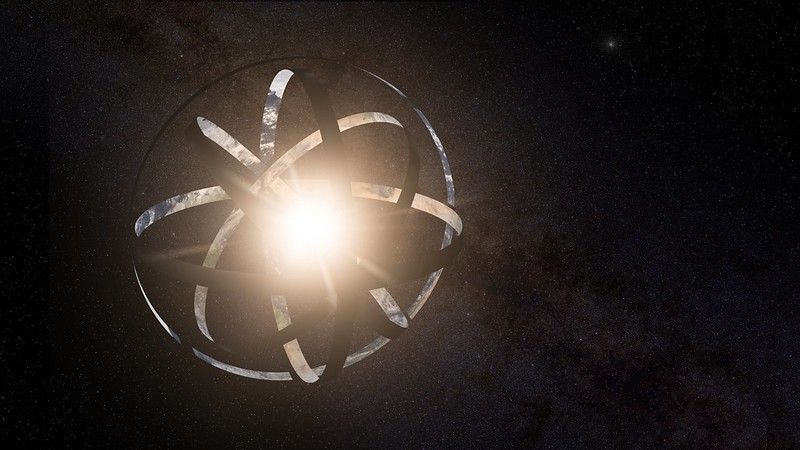
Andy Tomaswick explains that an advanced civilization could harvest a black hole's energy by surrounding it with a Dyson sphere to capture the emitted power, but even with complete energy capture the heat would radiate in the infrared and could be detectable by telescopes like WISE and SDSS; an international team led by National Tsing Hua University analyzes six potential energy sources around a black hole—cosmic microwave background, Hawking radiation, the accretion disk, Bondi accretion, the corona, and relativistic jets—with the accretion disk capable of providing hundreds of times more energy than a main-sequence star for a stellar-mass black hole, making a full sphere extremely challenging with current materials, though a Dyson swarm or Dyson bubble could collect energy without the same material strength at the cost of added complexity and reduced efficiency; to maximize benefits such a structure would reside outside the accretion disk, and even detecting a single sphere would push a civilization to Type II, but some energy inevitably becomes infrared heat that telescopes like WISE and SDSS could spot out to about 10 kiloparsecs (roughly a third of the Milky Way), with no evidence yet and consistent with Fermi's Paradox, though re-analyzing current infrared data for unexpected emission from empty regions could be worthwhile.