
Hidden Crashes, Hidden Physics: A Critical Inquiry Into Secrecy, Theoretical Prospects, and Transparency in a UAP Program
To the point
Davis argues that a secret, decades‑long UFO crash‑recovery program runs under heavy NDA secrecy with a broad network of engineers and fragmented leadership, lacks core theoretical physicists, entertains fringe ideas like wormholes, cites Bob Lazar as a caution, and calls for serious, transparent, interdisciplinary inquiry.



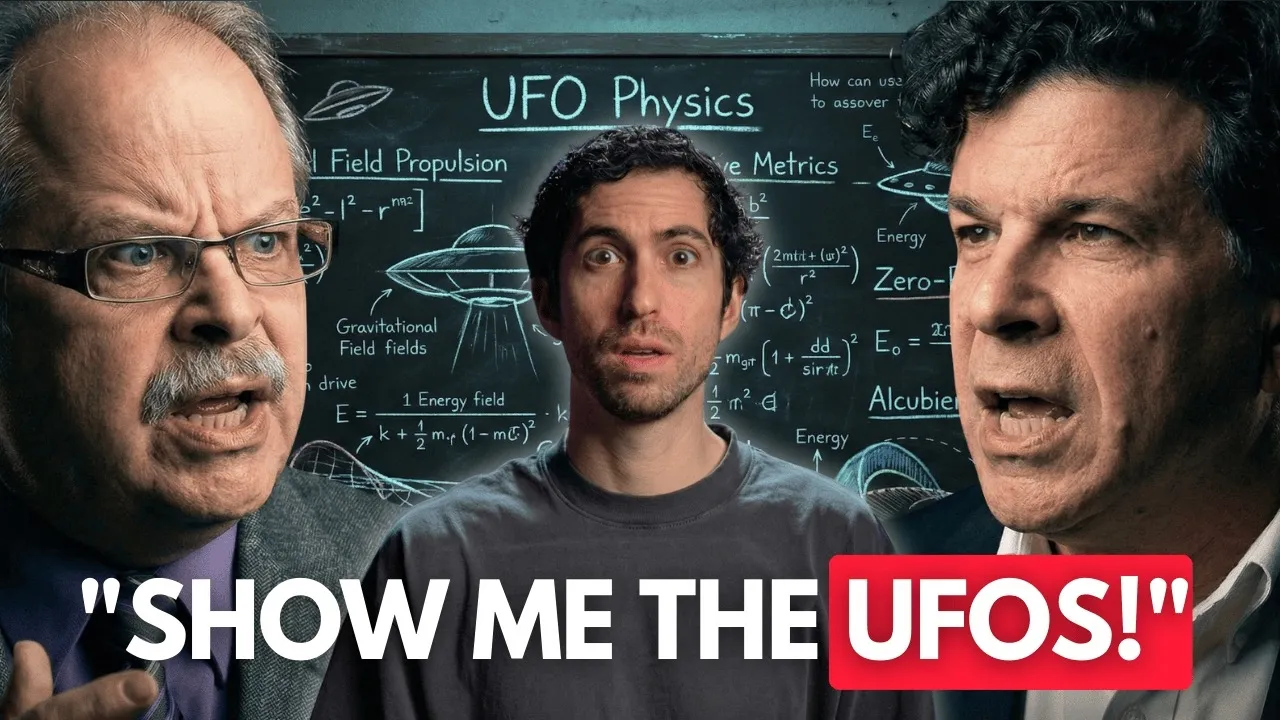
The discussion centers on a long-running UFO crash retrieval and reverse-engineering program, with Davis asserting real crashes like Roswell and a Corona site, plus a broad network of engineers operating under heavy compartmentalization and secrecy. They emphasize the absence of theoretical physicists on the core program, the NDA culture, and the difficulty of obtaining incontrovertible evidence due to classification. The speakers compare this effort to the Manhattan Project, arguing it is not a centralized, multi-disciplinary war-time undertaking and suggesting leadership is fragmented across agencies with only a small core portfolio owner. They debate the plausibility of using general relativity and the standard model to access traversable wormholes, acknowledging provocative ideas but remaining skeptical about practical propulsion within known physics. They explore exotic avenues such as extended electromagnetics, Pontryagin and churn-Simons actions, and the possibility that a geometric unification could reconcile gravity with the standard model, though no consensus emerges. They grapple with the epistemic fragility of observables and witnesses, noting NDA constraints and whether accounts from observers and insiders reflect genuine physics, misinterpretation, or strategic obfuscation. They speculate on the role of elite private sectors (like Renaissance Technologies and the Santa Fe Institute) as potential hubs for advanced physics, and whether a hidden network exists that avoids academia. Bob Lazar and the theta-term discussions surface as cautionary examples of fringe physics—intriguing yet controversial and easy to misrepresent. The conversation ends with a call for serious, interdisciplinary inquiry and greater transparency, proposing an elevated symposium where physicists could evaluate potential real physics behind UAP and crash-derived technologies, while acknowledging the political and security barriers to disclosure.
Source: youtube.com