
An Illustrated Definitive Roswell Chronology: Four Sites, Debris, and Witnesses (July 1947)
To the point
An expanded Roswell chronology, drawing on Don Schmidt and Tom Kerry’s Witness to Roswell, lays out four interrelated sites and a July 1947 timeline, cites witnesses such as Dan Wilmont, Major Jesse Marcel, and Sheridan Kavitt, describes unusual debris—fused green glass and a bread-box–sized black box—and an egg-shaped escape pod traveling southeast with two bodies ejected east of the debris field and a survivor at a northern crash site, portrays a military cover-up with intimidation and debris removal, and argues the craft and its occupants were extraterrestrial or extradimensional, while calling for continued secrecy and ongoing research.


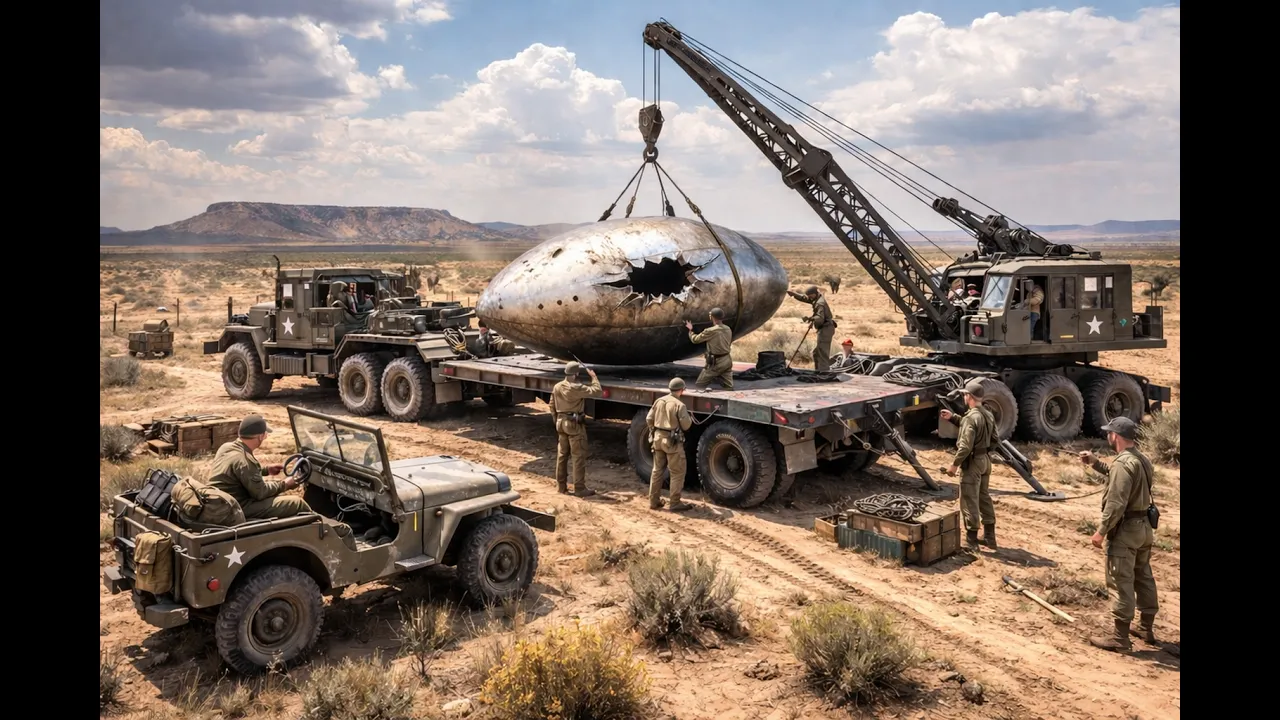
The piece presents an updated, illustrated Roswell chronology that aims to be the definitive timeline, crediting Don Schmidt and Tom Kerry’s Witness to Roswell as a foundational source while expanding the map to cover four interrelated sites and a complex sequence of events in July 1947. It argues against weather-balloon explanations by detailing four key locations: the touchdown site five nautical miles north of the debris field, the Foster Ranch debris field where fused green glass and a seamless bread-box–sized black box were found, the Droctor (second) body site two bodies ejected east of the debris field, and the crash site 35 miles north of Roswell where a survivor remained. Debris types are described as including tiny, uncut, unburnable foil-type fragments, memory metal that crumpled and reformed, and I-beams with pastel hieroglyphic-like writing, alongside an alleged main craft that disintegrated with an egg-shaped escape pod traveling southeast. The account layers firsthand witnesses—Dan Wilmont, two Roman Catholic nuns at St. Mary’s Hospital, Matt Brazzle, and others such as Major Jesse Marcel and Sheridan Kavitt—into a chronological narrative of July 2–12, 1947, with photos and renderings of the sights and craft. It also recounts the military’s formidable push to control the narrative: threats to witnesses, the removal and concealment of debris, the use of burlap bags and later industrial vacuums to scrub the field, and even the destruction or withholding of records, as highlighted by Steven Schiff’s 1995 report. The narrative follows the debris’s journey to Roswell Army Airfield, Hangar P3 (Building 84), and onward with the bodies aboard a B-29 (the Straight Flush) to Wright-Patterson, while noting corroborating testimony from Pappy Henderson’s wife and others about the transport and the alleged extraterrestrial nature of the occupants. It introduces the extraordinary claim that some observers, like Ern Steinhoff, considered the Roswell craft extraterrestrial from our future or extradimensional, a view echoed by other figures such as Marian Black McGruder and discussions of artifacts analyzed by Battelle and MIT. The author repeatedly emphasizes the ongoing secrecy surrounding the event, the persistence of witness intimidation, and the need for continued research, including distributing updated flyers to preserve memory and pursue the truth.
Source: youtube.com