springer.com
Life on the Edge: Bioprospecting Extremophiles for Astrobiology - Journal of the Indian Institute of Science
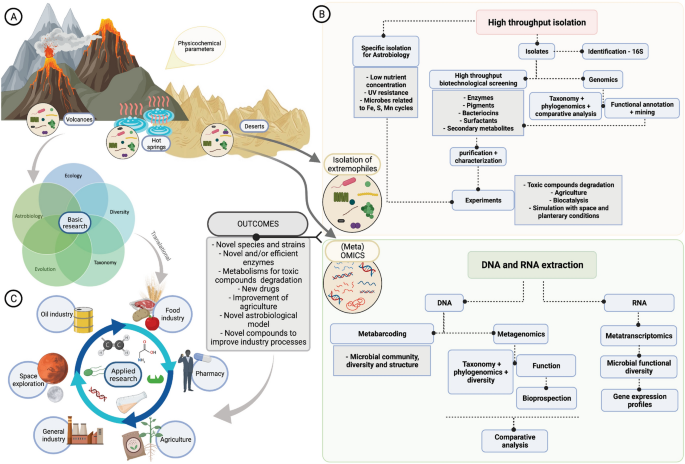
Discovering exoplanets and satellites in habitable zones within and beyond our solar system has sparked intrigue in planetary setting varieties that could support life. Based on our understanding of life on Earth, we can shed light on the origin, evolution, and future of Earth-like organisms in the galaxy and predict extinct or extant extraterrestrial life. Hence, extremophiles thriving in mimic outer space environments are particularly interesting as they exhibit traits that preponderate our comprehension regarding the possibility of life elsewhere and in situ life detection. Additionally, many extremophiles have been used for astrobiological research model organisms to unveil native alien life or possible life-produced metabolites outside Earth. Laboratory-based simulation chambers mimic this outer space condition, helping researchers study life beyond Earth in near identical conditions and understand molecular mechanisms for survival. This review summarizes relevant studies with isolated microorganisms from extreme analog Earth environments, harnessing them as promising astrobiological model candidates for pursuing life potentialities in other planetary bodies. We also highlight the necessity of environmental simulation chamber approaches for mimicking extraterrestrial habitats.