
Towards a Unified Eupfology: An Interdisciplinary Map for Studying Anomalous Phenomena




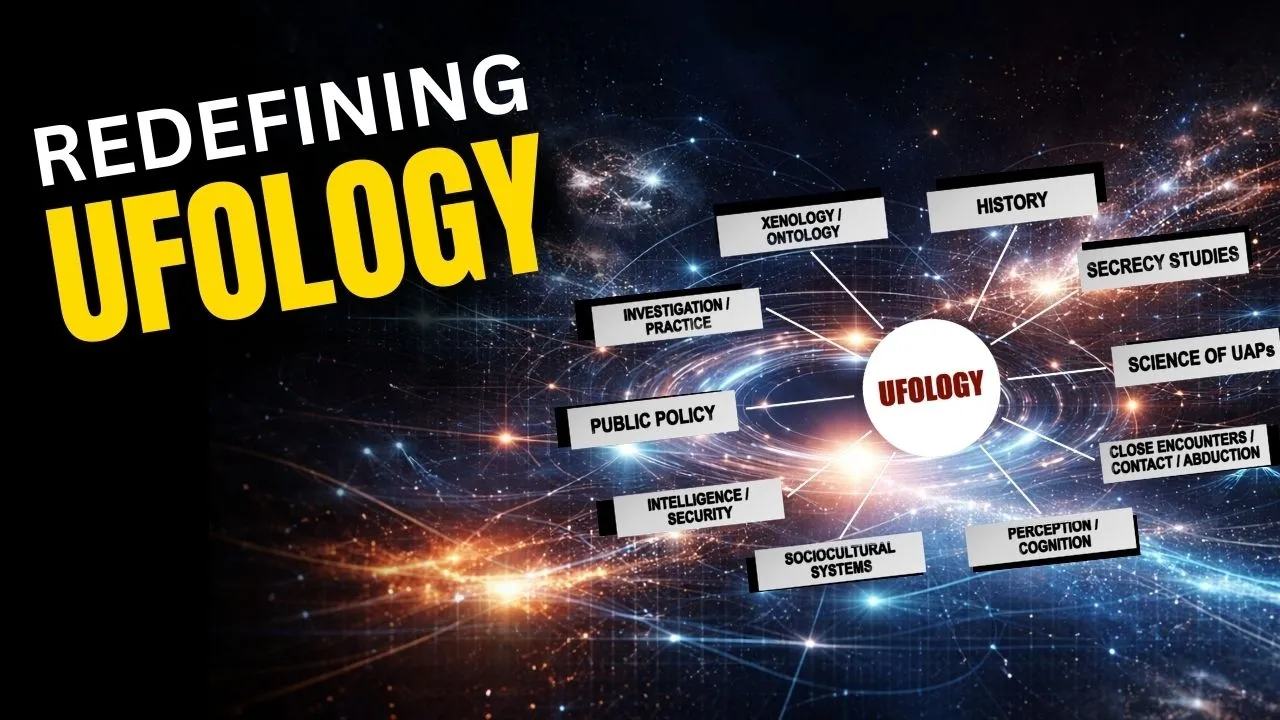
A speaker argues that the UFO/UAP field has grown dramatically in public attention, but its study remains fragmented. He proposes treating eupfology as a genuine, interdisciplinary discipline and offers a map to unify the field’s many strands without extinguishing the mystery. Key ideas and proposed framework - Object and aim: Eupfology should study anomalous aerial/ocean/space phenomena and the human interface with them, not only pursuit of sightings but also the wider social, historical, and scientific context. - Interdisciplinary map: The field should be organized around multiple pillars that connect science, history, governance, culture, and human experience. No single approach should dominate; each pillar contributes a piece of the whole. - Historical backbone: A dual focus on the factual record (timeline, archives, evidence trails, programs, and data) and the historiography of how researchers have built or distorted the narrative over time. - Secrecy and cover-up studies: Examine mechanisms of concealment, classification, and information management, as well as psychological and cultural factors that conditioned public perception and ridicule. - Science of UFOs: Treat the phenomenon as a site where many sciences intersect—flight dynamics, propulsion, materials, isotopic analysis, radar/IR data, and related biological, environmental, and even frontier physics questions; acknowledge that space-time, quantum information, and consciousness-related questions may arise. - Human experience domains: Include contact, abduction, and near encounters; study the long-term experiences of witnesses and experiencers using appropriate psychology, medicine, and ethics. - Xenology and ontology: Investigate non-human intelligences and their possible biology, behavior, communication, and intent, while also examining what reality means in light of radically different intelligences. - Human factors and cognition: Explore how perception, memory, stress, lighting, motion, expectation, and group dynamics shape reports and memory, including altered states of consciousness and information transfer. - Sociocultural systems: Track how societies reinterpret the phenomenon through media, religion, myth, online communities, and culture, and how narratives influence policy and power. - Intelligence, counterintelligence, and security: Analyze actors behind the phenomenon, patterns of behavior, source validation, and national-security implications, including how information is controlled and how narratives are managed. - Policy, ethics, and governance: Address disclosure, risk communication, classification reform, whistleblower protection, ethical treatment of experiencers, and frameworks for handling potential non-human life. - Field investigation and professional practice: Establish on-scene, evidence-handling protocols, calibration, chain of custody, transparency with peer review, and balancing openness with confidentiality to build a rigorous practical backbone. - Guardrails and standards: Across all pillars, implement evidentiary standards, disciplined data handling, active testing of one's own hypotheses, and strong ethics/privacy protections to maintain credibility and public trust. Bottom line and outlook - Eupfology already possesses the components of a discipline (object of study, enduring questions, methods, data, and cross-disciplinary links) but has been fragmented into siloed efforts. - A coherent map would show where different approaches belong, how they relate, and how knowledge can accumulate over time, rather than being restarted generation after generation. - The proposed framework is intentionally starting a conversation; it invites critique, refinement, and collaboration to move toward a more integrated, responsible, and credible eupfology that addresses air safety, national security, environment, human well-being, and belief itself. - Uncertainties remain, including various competing hypotheses (extraterrestrial, interdimensional, timeshifted humans, machine or consciousness-based models, etc.) and the need to navigate them with careful evidence standards. Overall, the speaker advocates redefining eupfology as a mature, interdisciplinary discipline with a shared map that coordinates diverse specialties while preserving the core mystery.
Source: youtube.com