
From Dismissal to Disclosure: Congressional Discourse on Unidentified Anomalous Phenomena and the Disclosure Foundation's Three Pillars
To the point
Leaders Jordan Flowers, Dylan Guthrie, Kirk McConnell, Anna Brady Estz, and Avi Loeb are driving a bipartisan push to study and disclose unidentified anomalous phenomena as a national-security issue, defining UAPs by six observables and guided by The Disclosure Foundation’s policy research, legal work, and public-education outreach while navigating political hurdles and diverse state, non-state, and media actors with an insistence on careful, evidence-based analysis.



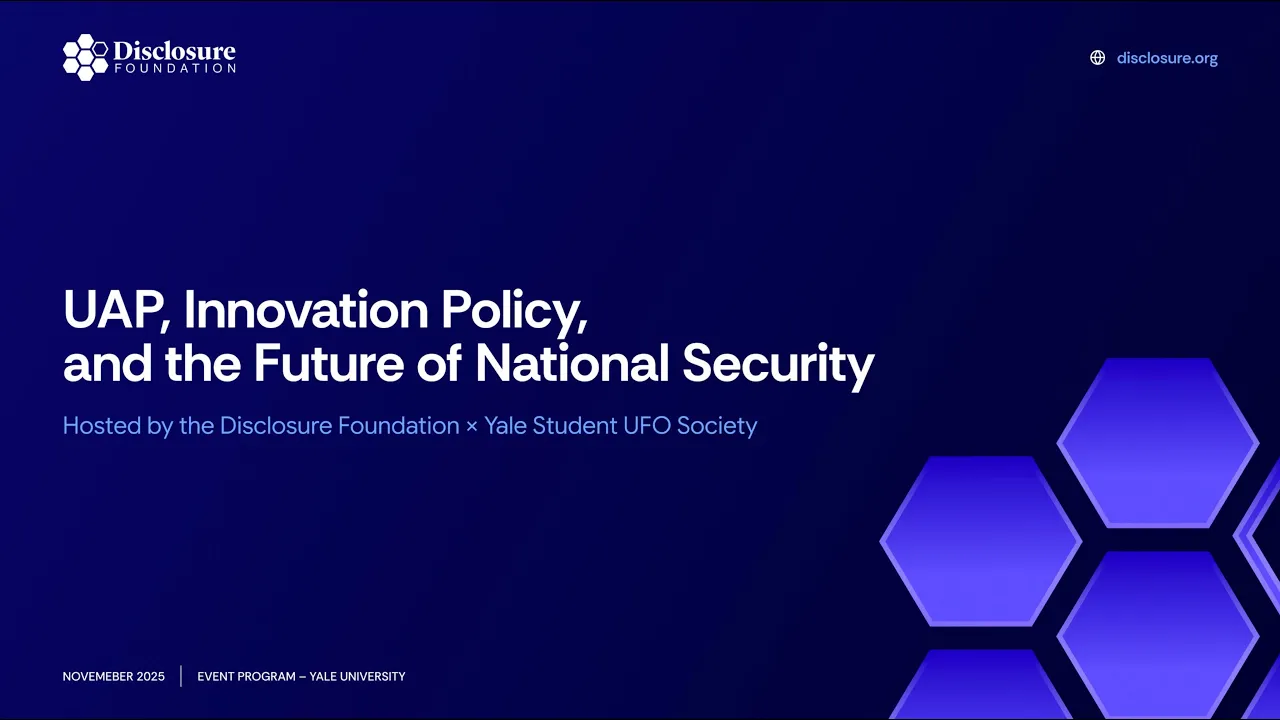
A distinguished lineup explored the surge of interest in unidentified anomalous phenomena, with leaders like Jordan Flowers, Dylan Guthrie, Kirk McConnell, Anna Brady Estz, and Avi Loeb outlining the moment’s congressional investigations, whistleblower testimony, and moves toward disclosure. The Disclosure Foundation frames its work around three pillars—policy research to inform legislation, legal efforts and whistleblower support, and broad public education across Congress, academia, and industry. Dylan Guthrie outlined UAPs as a national security puzzle defined by six observables—instantaneous acceleration, hypersonic velocity, low observability, positive lift, transmedium travel, and biological effects—while noting that intentions behind these phenomena remain unclear. The discussion highlighted a historical shift from dismissiveness to acknowledgement and pointed to gaps in public threat assessments despite statutes calling for threat evaluations and offices like ARROW to synthesize data. It framed disclosure as an inherently multilateral, arms-race-like challenge with many states and non-state actors, raising questions about implications for nonproliferation and strategic stability. The UAP Disclosure Act was described as bipartisan but hard to pass because of cross-cutting jurisdiction across committees, prompting consideration of alternative paths and stronger whistleblower protections. Kirk McConnell offered insider perspective from decades in Congress, affirming credible testimony about crash retrieval and reverse-engineering programs while acknowledging procedural and political hurdles and past missteps in the executive branches. The speakers also considered the role of non-government actors, investors, and media, including the Age of Disclosure documentary, in building political capital and accelerating transparency. Across the board, there was agreement that evidence—whether sensor data, eyewitness reports, or insider disclosures—must be weighed seriously, even as skeptics urge careful, multi-hypothesis analysis rather than rushing to certainty.
Source: youtube.com